Thursday, September 14, 2006

Desert RATS

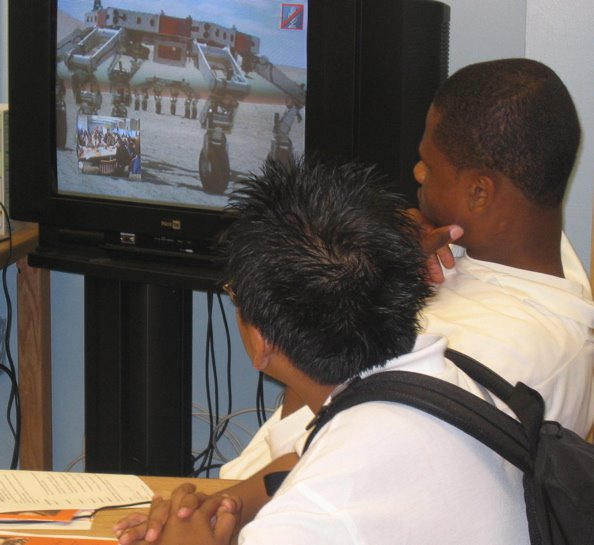
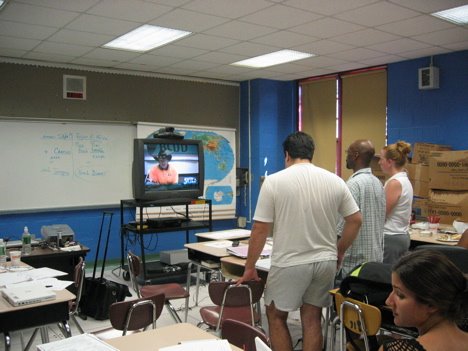
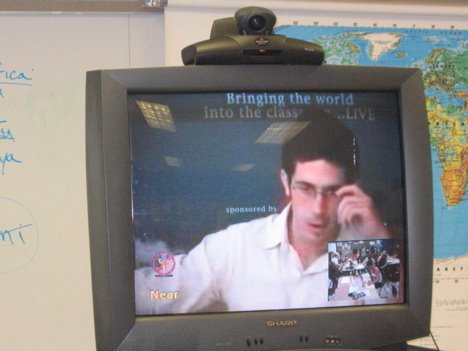
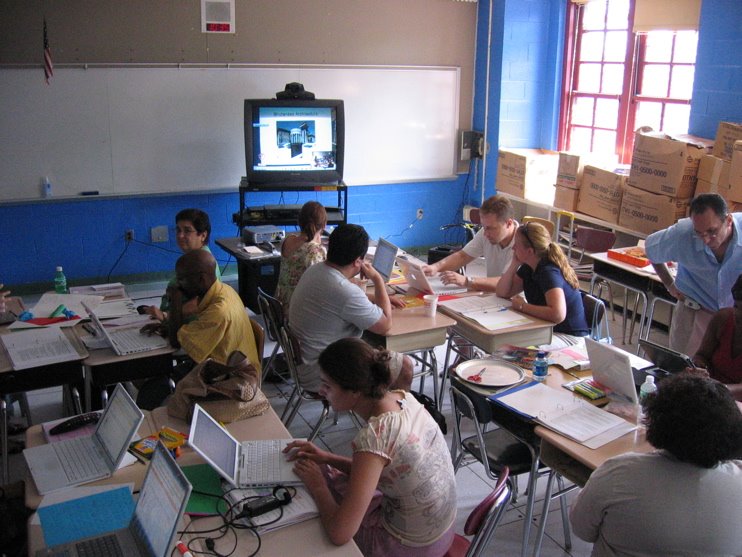
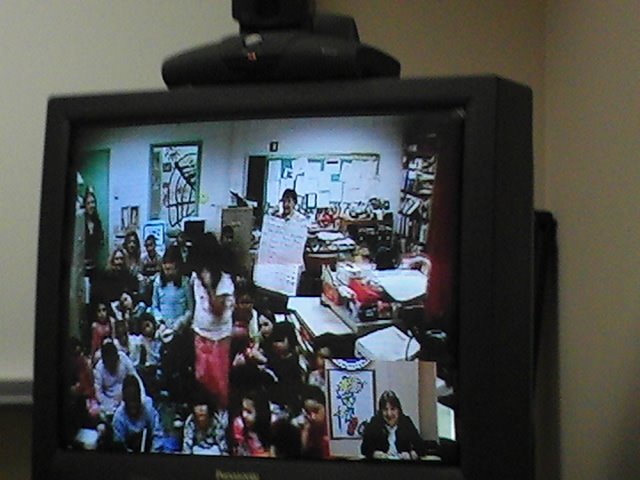
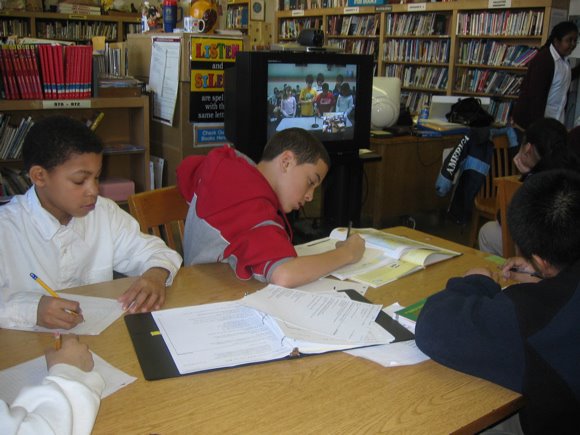
Our first videoconference this year was with NASA and one of our 8th grade science classes. No it wasn't about those long tailed, not so popular rodents but rather about space research being conducted out in the Arizona desert. RATS is an acronym for Research and Technology Studies. This program provided our students an opportunity to hear and see NASA scientists as they worked in the Arizona desert. They also were given the opportunity to ask questions. Since this was a multipoint connection there were 4 other schools participating. The first part of the vc unfortunately our students missed because we lost connection with the bridge. Since the bridge called us I had no way of dialing them. When I called the bridge it went to a message machine. When I called my contact at NASA it went to a message machine. I even called one of the other schools that were connected and asked them to let them know we were no longer connected. FRUSTRATION. I FELT LIKE I WAS A RAT IN A MAZE. Finally I got through to NASA and someone got through to the bridge. The bridge called us back and the rest of the 50 minutes were wonderful. Our students were able to see how NASA scientists and engineers are using the earth’s terrain to test equipment that will be used by astronauts to work on other planets. They saw a robot vehicle called the All-Terrain Hex-Legged Extra-Terrestrial Explorer or ATHLETE (another acronym). NASA really likes using acronyms. The students also saw spacesuits, boots, and gloves up close and personal. Did you know that the spacesuit weighs about 250 pounds. That's a lot of fabric. And not your most comfortable clothes for the hot Arizona desert. But the heat in Arizona is nothing to the temperatures in space. So, the students saw how this spacesuit cools of the body. The students learned so much about the experiments that are being done in the desert. One student asked "what surprises they found in their experiments?" The NASA scientist answered there are many surprises. In fact he said there is no such thing as a failed experiment. You may not find what you thought you would but you always learn something. Most important of all was the message that all the scientists gave to their audience of middle schoolers. Find your passion and pursue it. Don't give up. As one NASA scientist said, "be like a postage stamp, stick to it until you reach your destination". Good advice.

Thursday, September 07, 2006

Hit the Ground Running


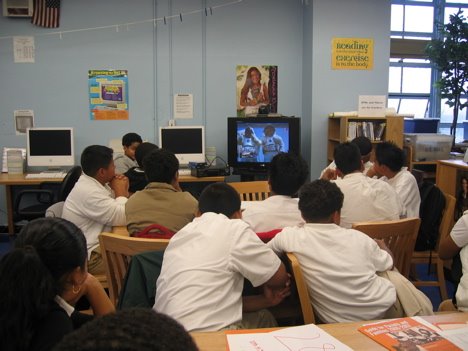
It's back to school and back to videoconferencing. This year our schools are videoconferencing in September. I think this is a first. It use to be don't even mention the "V" word until October and even then it wasn't until late October that things got going. Now I find schools have dusted off the monitors, hooked up the Polycoms and started making test calls and school just started on Tuesday! What's going on? Is videoconferencing becoming the user friendly technology and not the exotic equipment in the corner it use to be? From the looks of things I would have to say "yes". In late August I received some interesting videoconferencing invites. NASA had a special event in early September and a school in Texas was looking for six urban school and six rural school partners. I sent out e-mails and to my delight I got enthusiastic responses. So, while our students are still learning their classmates names and room numbers, they will be meeting other students as far away as Alaska these first weeks of school. They will be questioning the scientists in the Arizona deserts as a springboard to their studies of space exploration and robotics this year. Tomorrow I and another teacher will be getting a lesson on using a Vtel videoconferencing unit from Paul Hieronymus, Technical Coordinator from Avon, Ohio. September is looking very busy and by the way, yesterday I registered for the last videoconference spot for a program at the end of March.

Saturday, August 05, 2006

And All That Jazz

I just finished facilitating the 5 day videoconferencing training, 123VC Jazzing Up Your Curriculum with Videoconferencing. It was quite a training. Over the course of 5 days, a group of 16 teachers and myself submerged ourselves in videoconferencing activities. Almost the entire workshop was a videoconference either with 4 or 8 different schools collaborating. As luck would have it New York was in the grip of a record breaking heatwave. With the temperatures hovering at 100 degrees and the actual feel good temperature at 115 power saving became a real issue. The air conditioning barely worked. The internet stopped working along with the elevators. So, our working conditions were rough but the workshop was so engaging that my group of "sweet 16" endured.


Most of the mornings were simulation activities of already successful collaborations. We had fun doing math in "Math Marvels". We had a great time doing MysteryQuest Beaches. Based on the MysteryQuest model. The ASK program was a moving morning of listening to a beautiful reading of The Wall and then reflecting on this touching children's picture book. We also had time to interview a Vietnam Veteran, Don Alsbro. After lunch each day we listened to speakers discuss specific videoconferencing programs. I even got a chance to present our wonderful Poetry Slam Program. I enjoyed hearing David Macquart talk about his Global Nomad Group. I know I would love to be involved with one of their programs this year. Videoconferencing provides such a wonderful opportunity for students to have a real dialogue and with the many global issues effecting our world today this type of communication is more important than ever.

Every afternoon our teachers broke into small groups to work with their colleagues in Texas on a project they designed for their classes. These projects were complete with a lesson plan with pre- and post-videoconferencing activities as well as the actual videoconference itself. There was also a timeline, an advertisement for participation and resources included. They did this collaboratively posting their information in a wiki. When they left the workshop Friday afternoon for some much deserved airconditioning, rest and relaxation they had a videoconferencing project in hand and partner(s) for the coming school year. I look forward to the fruition of these projects. The six projects my groups helped to develop touched a variety of content areas and grades. " A Walk Across America" is a 2nd grade Social Studies project about community. "It's up to you to preserve your world!" a 5th grade science project, "Songs of the 80's" a computer technology and language arts project.
"Start Spreading the News" an 8th grade broadcast journalism program. "Caldecott Decades" an elementary grades library project and "Geometry Jeopardy" a Math program for 3rd-5th graders. I'm looking forward to blogging about these programs in the future. Today, I'm happy to be starting my summer vacation. Oh, and the temperature outside mid 80's, low humidity. Go figure.

Monday, July 31, 2006

Day 1 of Jazzing Up the Curriculum


Today I woke up at 5:30 AM (EST) to get a good start on the first day of our 123VC Videoconferencing Training. Does that mean my colleague Ashton in El Paso had to get up at 3:30 AM (Mt.)? I stopped off to buy coffee and bagels for the group, set up the videoconferencing equipment in the room and greeted the participants as they arrived. There are 15 teachers in our NYC group. The local activity time was way too short and before I knew it we were connected to three other school districts all in Texas. I made the "jumping in to the deep end of the pool" analogy for my NY teachers who for some had never even seen a videoconference. Things pretty much went that way all day. Learning by doing. By the time the day came to an end I had a group of videoconferencing veterans. They were muting the audio, panning and zooming, chatting in chat rooms and making IP connections like pros. I'm exhausted but excited and looking forward to Day 2.

Read Around the Planet

Sunday, July 23, 2006

Getting Ready for 123VC Jazz


During the week of July 31st through August 4th, 18 teachers from my Region and I will be participating in a most unique and exciting videoconferencing professional development. It is called 123-VC! Jazzing Up Your Curriculum with Videoconferencing. The unique part of this PD is that it is conducted almost entirely through live interactive videoconferences with other teachers in Michigan, Texas and Missouri. It is also an opportunity for the participants in this training to simulate the kinds of projects and collaborations that their students will be doing in the coming school year. The planners which include distance learning leaders in 8 different school districts in 4 states have been working on this training for months and are using Moodle an online collaborative management system to develop the entire course. From schedules to handouts, from readings to blogs everything is posted in this online environment. The logistics of this training is daunting. Each day after a brief half hour of local time "taking care of business" and introducing or going over some of the important topics each location will connect to usually three other districts. One of the days all eight groups will connect to each other. Then all the participants will be introduced to a project or projects and then simulate the activity and videoconference that the project requires. Of course the simulations will be light hearted. For example "MysteryQuest" a geography program where students research cities and countries in the World will be turned into "MysteryQuest Beaches". Our teachers will be finding those pleasure spots where sand and surf and fun take center stage. After lunch all eight sites will connect together for an hour to hear speakers on special topics. Then (and here is where logistics and daunting come into play) all 18 of my teachers will break into much smaller groups to connect to similar small groups to work on a vc project to do with their classes in the fall. So, I will need to provide at a minimum 5 other videoconferencing sites.
This week the pressure is on to ready the middle school we will be meeting at so there are at least 5 locations in the building where the teachers can go at the end of the day for their small group projects. I already have a vc unit in the media center. Another room that has an ISDN connection and is air-conditioned I hope to use for the majority of the day. However, I already had problems with the ISDN lines last Friday. So, I need to contact our local phone company Verizon first thing tomorrow. I hope to get another cable modem for the other library in the building and have cable installed in one of the computer labs. Of course I need to borrow additional Polycom units. Since the school right now has only two. So, my to do list for tomorrow looks something like this:
1. Call Verizon for ISDN repair.
2. Confirm TimeWarner for install on Tuesday.
3. Borrow 3 VC Units. Set-up and test.
4. Order breakfasts and lunches for five days.
5. Purchase binders for handouts
6. Copy handouts and fill binders
7. E-mail participants reminding them about the workshop (It is summertime and they do forget).
HELP!!!
Tuesday, July 11, 2006

Reflecting On NECC


It is exactly one week since the opening night program of the NECC 2006 conference. One week ago I ate my first corn dog and stood on the terrace of the appropriately named Sails Pavillion and watched the fireworks in the San Diego sky. I am usually on the opposite side of the country watching the Macy's fireworks over the East River. No matter, the feelings are always the same, a surge of patriotism and of course anticipation for the summer vacation that is before me. That night it was excitement for NECC and the experiences that woud unfold in the next few days.. NECC did not disappoint. As usual (this is my third consecutive conference) I felt like a kid in a candy store. Too many delicious choices and not nearly enough time. I like to use the online planner before I go but there are way too many triangles with exclamations points a warning sign of a conflict in my schedule. Anyway I got to do a lot of hands on workshops and sat through some very interesting sessions but most of all I got to network with so many potential videoconferencing partners.

Podcasting amd Moodle were two hands on workshops I really enjoyed. Videoconferencing is a blended technology. There is room for all types of other technologies and programs to enhance and extend the IVC experience. The pre-conference and post-conference activities afford the opportunity for many other technology applications. A collaboration tool like Moodle or a multi-media product like a podcast are great technology tools for students and teachers to incorporate into projects.

I also got to participate in a variety of live videoconferences. The Rock and Roll Hall of Fame does three programs. They look at the 50's and the 60's and the historical and political effects of Rock and Roll. I felt like something of a relic having been at Woodstock in 1969. I definitely want to see that videoconference in its entirety and of course I can be an eyewitness resource! I also got to see COSI (Ohio's Center of Science and Industry) and a look at their Open Heart Surgery live videoconference. This one is so popular that it is already entirely booked for the 2006-2007 school year. I saw a portion of the program and although fascinating NOT for the faint of heart. Another one I really enjoyed was a live visit with Jim Stovall, blind author of the book, The Ultimate Gift. He not only was an inspirational speaker but as an author provides an exciting interactive opportunity for students to read his books and then interview him. This is the purpose of ASK (Authors, Specialists, Knowledge) a videoconferencing project which is an organized process that provides students with the opportunity to interview an author or a subject specialist in the topic they are reading about in a novel. One live videoconference I participated in and definitely think I'll pass on is Grossology Live, a videoconference devoted to bodilly functions. I think the students would probably have a good time but there is something to be said for "good taste" in programming.

Probably the most fascinating videoconferencing session I attended was "HyperMirror Videoconferencing! Japan-LA-NJ Collaboration". The project was a water quality study between classes in New Jersey and Japan. The interesting twist was using the HyperMirror technology. This technique developed by a University in Japan uses chroma-key to merge two videoconferences into one so that the 2 sites look as one. I first saw this technology used with Internet2. It was very exciting to see it can also be used with our H.323 connections. The effect is obtained by using a blue screen. In this session two blue plastic tarps were hung and the presenters in San Diego and the students in Japan appeared to be together on the screen. I would love to incorporate this into some of our videoconferences this year. At the end of the session I had an opportunity to shake hands with the students in Japan. Talk about interactivity.

Besides all the wonderful sessions, exhibits, vendors and keynotes, I came away from NECC 2006 with a stack of business cards. Each card represents a project, or person or geographic location that I look forward to working with or connecting to this coming school year. The web is wonderful for finding videoconferencing projects but meeting someone face to face and sharing a good conversation is the best way to make a real connection. I'll keep you posted in subsequent blogs how my NECC encounters pan out.

Tuesday, June 20, 2006

Three Weathermen and a VC


June is a hectic month. But it is also a winding down month. As I tie together the loose ends i also want to blog about some of the vc's I didn't get a chance to write about. One of these videoconferences took place on May 26th. The Friday before the Memorial Day weekend. I wrote in a previous blog about a videoconference with two meterorologists from the Eastern Region National Weather Service. I spoke about that being the first vc of hopefully a continuing collaboration. So, when our Region was planning a Math, Science and Technology Fair for 5th graders with an emphasis on careers I contacted my friends at the NWS. To my total delight the program they put together was three sessions each hosted by a different meteorologist. Each talked about what got them initially interested in meteorology as a child. What kind of courses they took and educational route they pursued. They also talked about different job opportunities they had along the way to their present work with the NWS. Richard Watling an Operations Improvement Hydrometeorologist and leader of weather verification gave the first vc. A hydrometeorologist is branch of meteorology that deals with problems involving the hydrologic cycle, the water budget, and the rainfall statistics of storms. In short, a RAIN MAN. Mr. Watling talked about his childhood and his interest in clouds and space. How that early interest led him to a long and fulfilling career in meteorology. Then he fielded questions from a very fascinated audience. He answered everyone except the one about Planet X. That was a stumper The second meteorologist was Jason Franklin a Mesoscale Meteorologist and leader of aviation weather. In short a PLANE MAN. He talked about the important work of keeping our planes safe in bad weather. Our last meteorologist was Joshua Watson a Techniques Development Meteorologist and leader of science training and forecasting techniques. In short a WEATHER MAN. He talked about the different ways weather is forcasted and the satellites that are out in space. Three groups of students met three different meteorologists. Maybe one day some of these students will become a meteorologists themselves. They won't have to worry about one thing. A meteorologist is never fired for a wrong forecast.
NOAA’s National Weather Service

Monday, June 19, 2006

Poetry Slam Slammed

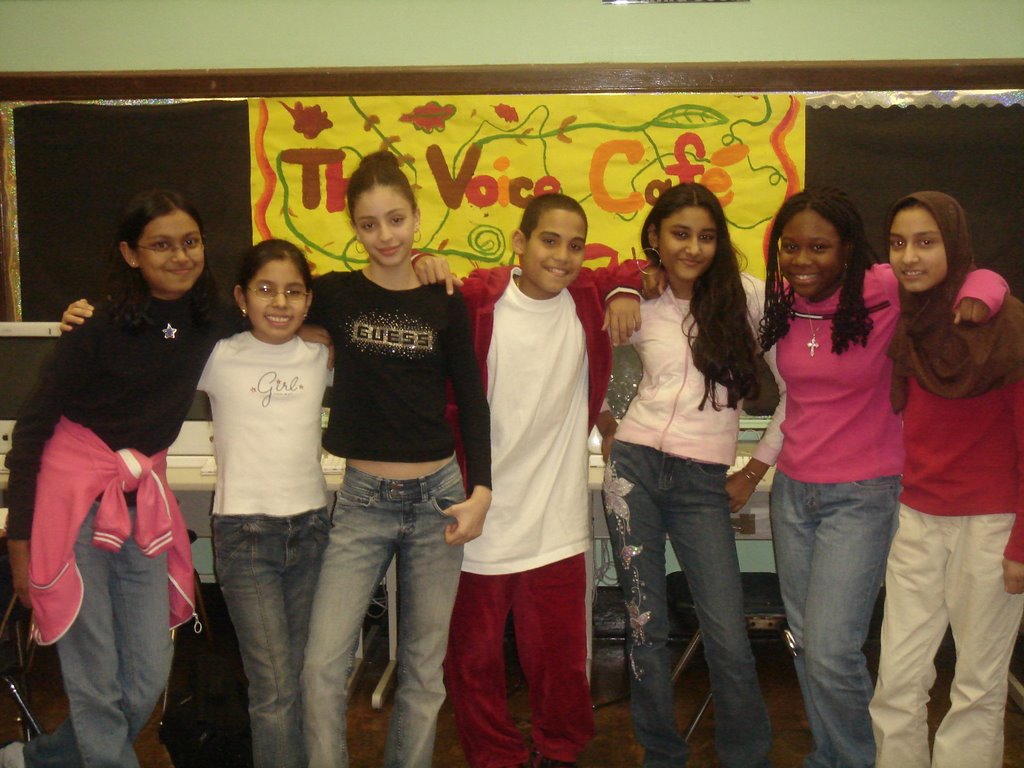
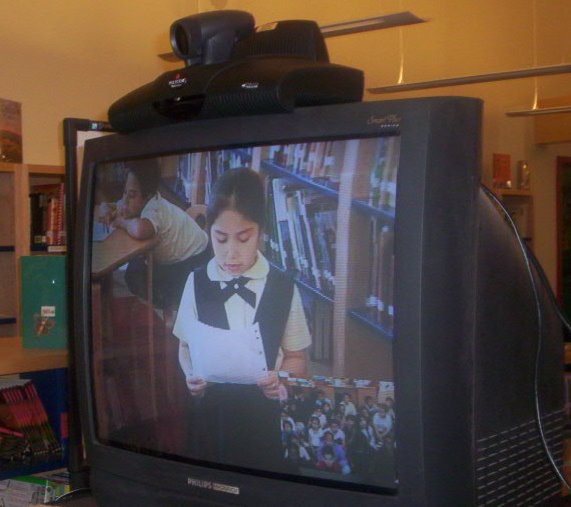
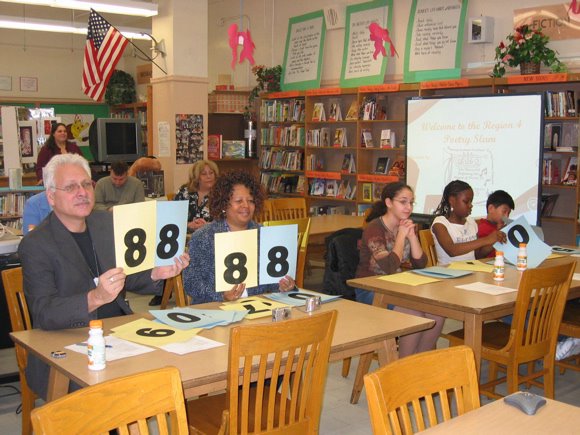
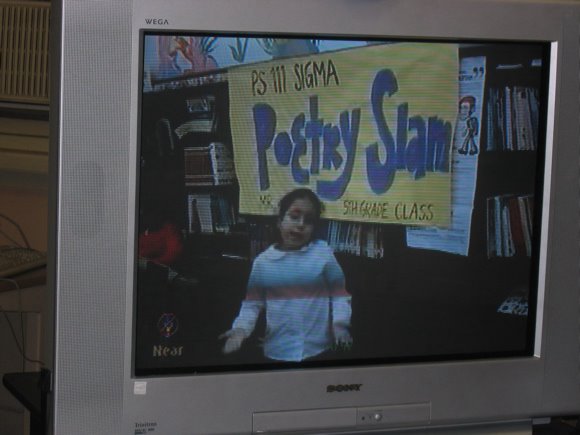
We had our spring poetry slam at the beginning of June. This is the second poetry slam this year. The first one was in February. This year there are eight schools involved in Poetry Slam. The poetry slam is a culmination of a ten week poetry writing residency that takes place once a week in the classroom. The students poetry really matured and developed between the winter term and the spring term. Their poetry is amazing. The topics are much deeper. The poems this term are more meaningful with real messages. I was totally overwhelmed by their poetry. The slam, which takes place entirely by videoconferencing, went fine on day one. The 5th/6th grade semi-finals were judged by a team of two adults and three students Olympic style.The 5 member poetry slam teams take turns performing their poems. The judges score them from 7.0 to 10. Then the team scores are added and the two top scorers go on the finals. The next day were the 5th/6th grade finals and the 7th grade finals. It started out fine but the connection began to deteriorate. By the end of the first slam we were experiencing significant freezing and muffled audio. A few attempts were made to hang up and redial. I spoke to the technician at the bridge but the problem was not with the bridge or our equipment. The problem was somewhere in between. The problem was in cyberspace. Finally, during our second poetry slam the decision was made to end the slam after the fourth round. The technology (which should be seamless) had brought our Poetry Slam to a halt. A few days later we had our inter-region slam with the Bronx and everything was back to normal. What caused the problem we will never know but on Friday, July 9th we had an Open Mic. Open Mic is a live event. Here all our students who want to perform their poems are invited to come up to the Open Mic. I started things off with a poem I was inspired to write after our videoconferencing fiasco.

Poetry Slam Slammed

Our poets were ready,
Their poems were supreme
But the technology
Had problems
And trampled our teams

Somewhere in the network
A glitch had appeared
It froze all our pictures
Our audio
You could hardly hear

Our poetry slam
Was stopped in its place
Our verses were lost in
Cyberspace

But not to worry
Our poems will be heard
Open Mic
Has arrived
We’ll hear every word
WORD!

In fairness to videoconferencing, this is the exception rather than the rule. But go tell that to the 5th round of poets.

Wednesday, May 17, 2006

Square of Life


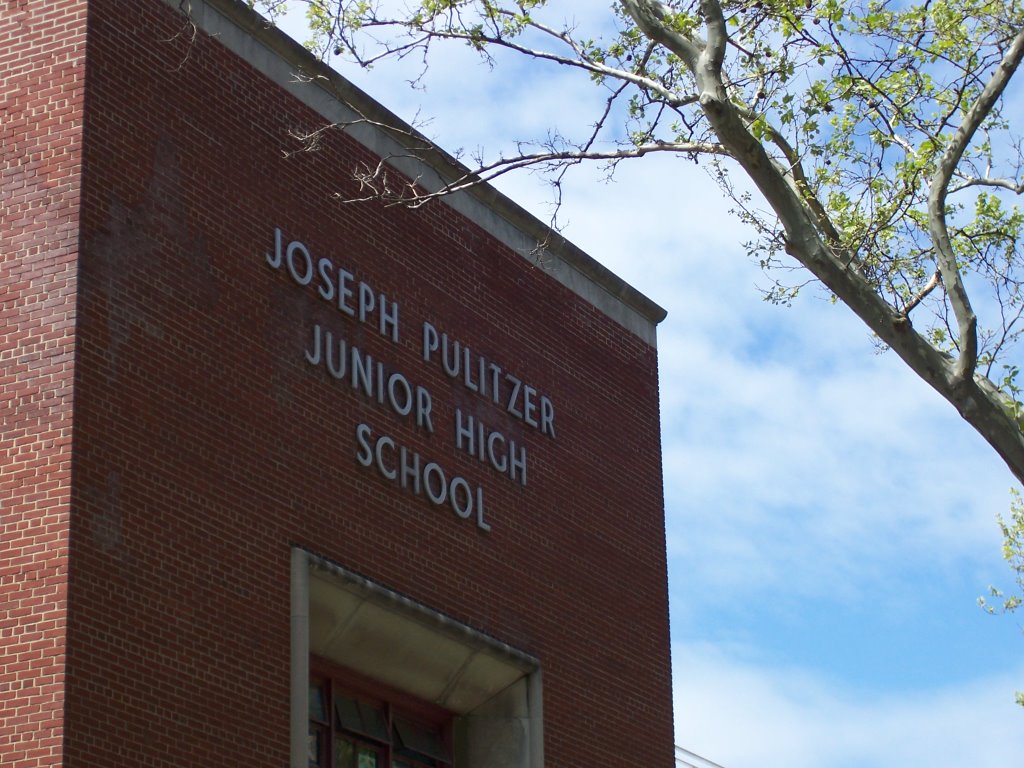
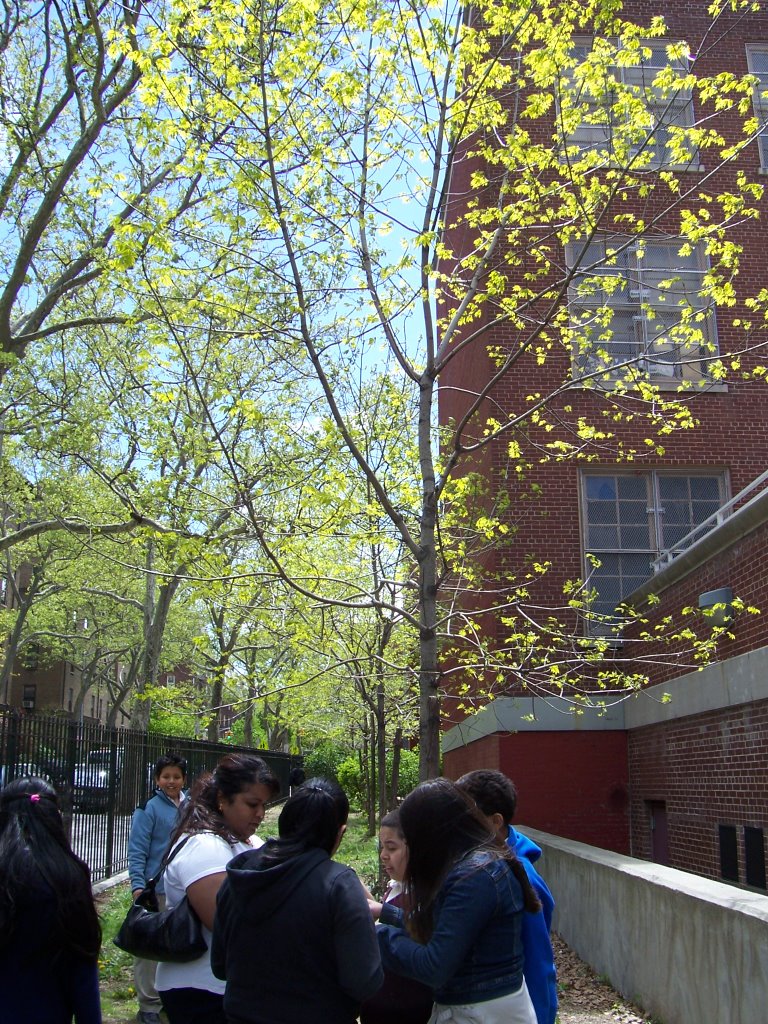
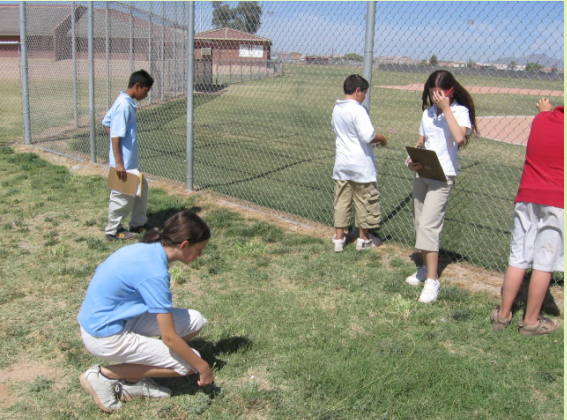
Today two sixth grade classes came together to share their findings and observations of the plants and animals that grow and live around their schools. This meeting and exchange was a result of an online project called "Square of Life".
http://www.ciese.org/curriculum/squareproj/
As part of this project students measure a square meter of ground and record what they find. I became interested in the project when I read that there could also be a videoconferencing component. I was put in contact with a school district in Arizona and we began the process of partnering some of our classes. Amy Chayefsky the distance learning coordinator from Maricopa AZ is a transplanted New Yorker and I am the mother of a University of Arizona alumni. So, we each had a real connection to each other's environment. One of the classes I found was a sixth grade science class whose teacher who was very interested in participating in the project. Of course we had to wait until the winter finished and the weather turned warmer for the students to explore their squares of life. In NY that means late April.

When our students went outside they observed the many trees that fill the tree lined streets. They measured inside the wrought iron gate that runs around their school where the dandelions and wood violets grow. Queens, New York is an urban community where plants and pavement vie for space.
Maricopa, AZ has few trees mostly desert soil and bush but also snakes and toads can be easily found. Where NY students live in apartment buildings with six stories the students in Arizona live in communities with six houses. Where our NY middle school has 2000 students, Maricopa's whole population is 10,000. So, you see besides learning about the different kind of plants that grow in these two distinctly different environments the students also learned about two different ways of life. There is much to learn from each other and about each other. Both classes prepared powerpoints that they shared with each other. Videoconferences like this are wonderful opportunities for this type of learning to occur. So, in addition to questions like do all kinds of maple tree give maple syrup there are also questions like what languages do the children in your class speak? Tomorrow is another Square of Life session in another one of our schools. I wish their could be more but Arizona schools start their summer vacations next week. Another difference our NY schools are open until the end of June. But just as our students began to moan when they learned about the early start to summer in AZ, I reminded our students that Arizona schools start in early August while New York schools start the second week of September. Viva le difference!

Friday, April 28, 2006

Hosting MysteryQuestUSA


I have written in a previous blog about how much I love the MysteryQuest videoconference. So when I learned that MysteryQuest USA for 5th graders was taking place while our schools were closed for our spring break I was very disappointed. When I suggested to Janine Lim, Instructional Technology Consultant for Berrien County Intermediate School District where MysteryQuest is coordinated, that maybe I could organize and host a MQUSA she said "great" and I was off yet again on a new videoconferencing adventure. First came the flurry of interested schools. The spots filled quickly and I even had to turn away some very enthusiastic candidates. Then I had to confirm the lucky classrooms of their participation. Next I had to schedule test calls with the bridge. A class dropped out and another space had to be refilled. Another confirmation letter. 5 classes couldn't make the test on the day assigned so I had to reschedule those classes. In short coordinating MysteryQuest had become a quest of its own.


When MysteryQuestUSA finally arrived I realized I had two of the same states participating on the same day (a no-no). I didn't have a countdown clock but rather a digital clock that showed military time. And two of my own schools that had worked so hard to prepare for the videoconference had their network shutdown (I still had two other classes participating). I would be hosting two MysteryQuestUSA programs. They each had 5 participating classrooms. One of the classes in honor of National Poetry Month delivered their clues in poetic form. The class from Paris, Texas performed their clues with incredible background scenery that made us feel we were at a Broadway Show. St. Thomas School in Wisconsin had beautiful posters that were painted on both sides so they flipped them over to reveal their clues. They were the most environmentally friendly presentation.


As for how the classes did with their guesses, almost every group got the right city and state. Are the students getting smarter? Are the clues getting better? Or is "google" making mystery cities and states an endangered species? Whatever the reason for the student's success it still is a challenging and engaging videoconference.

Tuesday, April 11, 2006

Meet The Dooples


Today we had part two of our "Meet the Dooples" author's share. This wonderful duo of books brings to life a group of everyday writing tools. The characters of these stories are Pencils, Pens, Markers...Crayons and Chalk, not to forget Racer the Eraser, who helps out if the others "mess up". The children love these engaging stories of rhyme, rhythm and repititions. But best of all is the fact that the author of these two wonderful books, Dr. Lynn Hunter, hosts the videoconference. So they not only got to meet the Dooples but they also got to meet their creator. Dr. Hunter also works for the NYC Department of Education as a Distance Learning Coordinator. I met her a few years ago and we have collaborated on some very interesting projects together. When I learned she was also a children's literature author I couldn't wait for her to do an author's chat.
The first videoconference took place two weeks ago. Two second grade classes were paired up. One in one of Dr. Hunter's schools in Manhattan and one in one of my schools in Brooklyn. Dr. Hunter read the story to the children as a powerpoint displayed the illustrations.

After an animated chat with the students a surprise animation of the story was presented. This animation was done by a group of middle school students in a school where Dr. Hunter worked. To see the characters come to life in such a creative way was just great.

The videoconference ended with the children being asked to write their own Doople adventure. Today during our second meeting these budding young writers shared their stories with Dr. Hunter and the other second grade class.
Then Dr. Hunter shared her second story "The Dooples and the Shapes". The children really enjoyed participating in this videoconference. I really loved the fact that our "talent" was all so home grown. There is a lot in store for the Dooples in the future. A group of older students are working on a "sequel" and a musical component to the videoconference is being developed. If you're interested in learning more about the books or videoconferencing with the author contact drlynnhunter@aol.com or go to go to http://dooples.com

Wednesday, March 29, 2006

Ask A Meteorologist

Today was the first of what I hope to be a successful videoconferencing collaboration with the National Weather Service. It all began several months ago when I e-mailed a meteorologist in Texas that offered videoconferences a few years ago. Many of our third grade classes were studying weather this year and I hoped I would be able to support them with videoconferencing. Then one day several weeks later Marcie Katcher from the Eastern Region National Weather Service, located in our own backyard (Long Island N.Y.) called to say that they had videoconferencing equipment and would be interested in trying to pilot a program with our third grade students. She even had a meteorologist who was interested in hosting the program. A livewire as I like to call anyone who volunteers to be involved in a videoconference. Especially a new venture. So, I became in touch with Rosemary Auld who is a real meteorologist. But it gets even better. She has a colleague named Jason Franklin, who is an aviation meteorologist, and he is interested in getting involved too. I was in videoconferencing planning heaven. One thing I really liked was that they suggested our students send to their offices a school weather mascot. I liked the idea that not only the students got to create something they also had an opportunity to have a personal connection with the National Weather Service. So, when the videoconference started today the first thing they saw was their "Weather Cheetah" right behind the head of the smiling meteorologist.


The videoconference started off with Rosemary Auld talking about the job of a meteorologist. She asked the students about their "Weather Cheetah" and what they were learning about weather. Then Jason Franklin got to tell the class about the job of an aviation meteorologist and how important their work is to keep planes flying safely. Then it was time for the students to ask questions. Another really nice touch here too. The students had e-mailed questions prior to the meteorologists. So, Marcie alternated between reading an e-mail question and having the student ask a live question. When she read an e-mail she asked the child who sent it to stand up. I know the students were very proud to have their questions read. One time she called out the name of about six students. She asked them to all stand up and hold hands. Then Marcie said their questions were all linked and that is why she wanted them to hold hands. They had all asked different questions about how weather moves.


The children also shared data they had been keeping everyday about temperatures. This is part of the globe project where the school has a weather station and they have instruments for recording weather information each day. This is really a 4th grade project but the 3rd graders are helping too. Rosemary Auld told them she would send them a box of materials so the could make their own weather instruments. Then they could compare how their school made instruments measured data compared to the special instruments they had in their school. The children were thrilled and very appreciative to be getting such an interesting package.


At the end the children were shown the National Oceanic & Atmospheric Administration (NOAA) website with a special site for children.

http://www.education.noaa.gov/students.html

I don't know what the weather will be tomorrow but today was sunny both inside and out.

Thursday, March 23, 2006

Producing Your Own Content


Here is another reason to add to the list of why videoconferences get cancelled "the teachers are taking strike action and they are having to shut the school that day, so the videoconference won't be able to take place". (For other reasons go to:
http://bcisdvcs.wordpress.com/2006/03/page/2/
I awoke to read this "urgent news" of the impending strike from our London partners. We had been planning a videoconference for months between our classes in New York and classes in London as part of WebPlay. WebPlay is an internet-based arts education project that links children from around the world to learn about theatre and each other. Our videoconference was going to be a sharing of what the children had written so far and a discussion of how to improve the writing in order to more realistically portray the sister cities. Our NY students wrote plays that take place in London while the London students write plays that take place in NYC.
Developing this videoconference was no easy feat. First we had to resolve the technology issues. The England schools use a web cam software "Click 2 Meet" and we use a Polycom with an H.323 protocol. My "mixed technology trials and tribulations" are clearly documented in previous posts. After successfully crossing that hurdle we had to write a lesson plan that would meet the objectives of what the videoconference hoped to accomplish. Of course you have to schedule the videoconference after consulting with the dozen or so people you are ccing in these cross Atlantic e-mails. The WebPlay people, the school coordinators, the teachers, the tech people and so on. Then with a little luck you hope the vc doesn't get cancelled.
Developing your own content is not an easy route to travel. Next week I am hoping to do a vc that has been in the works for several months with the National Weather Service. Again I worked on this from scratch, No cake mix for me. First I tried to find a meteorologist. Then the technology. Then the objectives, what do the children want to know? What do they know already? Then the schedules (school vacations, meteorologist business trips, school testing etc.) Today is Thursday, the conference is next Wednesday. Will there be a metorologist strike? Fortunately it's not hurricane season. I'll keep you posted.
Producing your own content, a true videoconferencing adventure!

Wednesday, March 15, 2006

When Irish Eyes are Smiling


When I was contacted in early February, about one of our 3rd grade NYC classes participating in a videoconference about St. Patrick's Day with a School from Cork, Ireland I immediately sent out an e-mail to all our schools looking for interested classes. I knew there would be "takers" but I had no idea of just how popular this program would be. I got so many responses from classes that were very enthusiastic to participate in the program. Not even the stipulation that a written lesson plan needed to be provided deterred those teachers from responding. It was difficult turning down so many. Why did this offer attract so many when so many other wonderful program opportunities attract so few or sometimes none at all. I think there were two elements that were very appealing. First of all the fact that a class in Ireland would be participating gave the conference an exotic component. Everyone loves an international connection! But the second element is that St. Patrick's Day is probably one of the most beloved holidays that is celebrated in our schools. As it was said more than once during today's videoconference "On St. Patrick's Day everyone is Irish".
Today was the day of the videoconference. The 3rd grade classes that participated in today's program were two of our classes from New York, one from Michigan, one from South Dakota and of course one from Cork, Ireland. Mrs. Healy's class from St. Vincent's School in Cork was using a videophone. All the other classes were using Polycoms. Bridging these technologies are still unchartered waters and although it worked yesterday during a test call, today only their audio made it across the Atlantic Ocean. So we listened to the beautiful brogues of the children in Mrs. Healy's class as they talked about the city of Cork and their celebrating of St. Patrick's Day. We learned that there are no specific foods for St. Patrick's Day and that often pizza is more popular than cornbeef and cabbage. Our students shared facts about their cities and how they celebrate St. Patrick's Day. They shared limericks and activities and got to ask a few questions.
I hope that we will get to see Mrs. Healy's class one day as videoconferencing is such a visual technology that it would be nice to have faces to go with those voices. I'm sure those Irish eyes are smiling but it would have been nice if we could have seen them.

Thursday, March 09, 2006

Our Videoconferencing Community


I just had a most interesting videoconferencing adventure. In December I participated in Megaconference 7 which besides being a great videoconference experience for myself and some of our students also got my name on the Megaconference distribution list. So for the past few months I get lots of e-mails from some of my few hundred plus friends who are also on the list. All the discussion in these e-mails center around videoconferencing and I can honestly say I've learned a lot. I even sent an e-mail once myself. I sent an e-mail with a query about the Click to Meet software and the H.323 protocol. I received about a dozen responses. I actually because of my e-mail wound up in touch with Stewart Duncan from the London Grid. This week we tested our equipment and now it looks like our NYC schools will be videoconferencing with their London schools. I liked this sense of caring and interest that the members of the megaconference mailing list have for each other. The time and thought they take to answering a question or help in solving a problem. So when Megan Troyer from Ohio State University sent out an e-mail looking for a videoconferencing site in NYC for one of their professors on sabbatical, I decided to be a good videoconferencing Samaritan and offer one of our middle schools to host the professor.

Today was the day of the videoconference. The professor was going to videoconference with her graduate design students to see their final projects via videoconference. The students had been working for the past 8-10 weeks on designing multi-media interactive computer programs about "Carnival" in Notting Hill, London. I was actually staying in Bayswater London at "Carnival" and didn't even see it but that's another story. So, I got to learn about it today through the graduate students at Ohio State University and their amazing projects. Each was so different and each was so interesting. Their professor was able to see and hear the student's projects and ask questions. (I told her to give them all A's and she agreed).
When I left the school today I jokingly told two teachers who came in the room as we were leaving if you're ever at Ohio State and need to do a videoconference... But seriously I do feel a tremendous sense of camaraderie from my experience with our videoconferencing community. I hope as it continues to grow, as I know it will, we will keep on helping each other by sharing our experiences, expertise and even our equipment.

Wednesday, March 01, 2006

Read Across America Meets Click 2 Meet


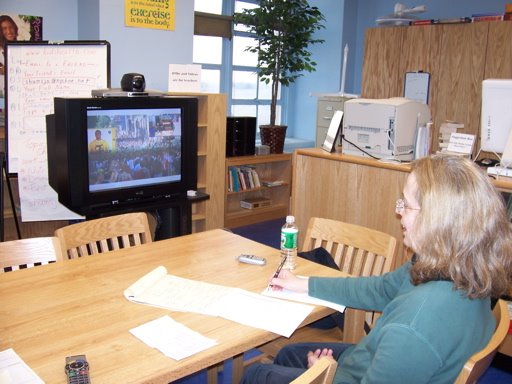
Today was our first Read Across America videoconference for this year. It was also our first time videoconferencing with a Click to Meet site and our Polycom room system. In other words Polycom VSX7000 meets Webcam. It wasn't terrible. Let me clarify that. I wasn't sure what to expect. I had pretty low expectations. The biggest problem was the audio. We heard everything we said twice. So, when our students talked we asked the other site to mute their mic. The video definitely was not as sharp as we are use to. There was no camera work at the Click to Meet. No zooming in and out, no panning right to left, and no presets. There was just one wide shot thats focus was soft. But we did hear and see them. We did have a good time learning about each other. Our students presented some Dr. Seuss poems and facts. They read to us The Three Little Pigs. We asked questions and they answered them. They asked questions and we answered them. The children enjoyed the experience and so did I. I think that the quality of the connection detracted from the program but I also think that if I had to choose to videoconference with a Click to Meet site or not to videoconference I would choose the former since the purpose of the videoconference was accomplished.

Monday, February 27, 2006

To Test or Not To Test


I am forever reminded of the importance of testing. Here are a few cases in point. Today I was at a school where they had 2 unsuccessful test calls. Since the school just started videoconferencing this year I felt maybe my experience would help. So I went to the school to see what I could do. It was not a routine H.323 connection but a Click to Meet site that was trying to connect to our Polycom VSX7000. I never connected before to this "different species". This was for a Read Across America conference on Wednesday and I knew time was running out. The Click to Meet site had to make the call. However, there was only audio, no video was transmitting. I knew I was in over my head and the only thing I could think of was to call Janine Lim who is chairing the Read Across America. I knew she had tested with all the participants and if anyone would know what to do it would be Janine. First I made a test call to Janine's Polycom VSX7000 to check our system was working properly. Then the Click to Meet site made a test call with Janine and she had the idea that instead of a 263 protocol a 261 should be used instead. Lucky for us it worked, The children would not be disappointed on Wednesday. Our test call had hopefully averted a disastrous connection.

Unlike two weeks ago when I attended a vendor presentation on using videoconferencing in the classroom. Here we were in a hotel conference room with state of the art videoconferencing equipment. An audience full of educators all eager to learn more about the technology of videoconferencing. A middle school at another location with a group of students and teachers enthusiastic to present their videoconferencing project. The call is made but the connection fails. The tech people go into high gear but to no avail. The problem is mystifying. They can connect to their home office but not to the middle school. So they went to plan B. You always need a plan B. There was a powerpoint which showed the project. A lively discussion about the project. But no videoconference. As I was leaving the vendor said to me "we tested the equipment with our office we should have tested with the middle school".

We have all had the experience of the technology not working as planned. I myself presented at a conference last year when I was unable to do a live videoconference as planned. I was also guilty of not testing in advance. I planned to test an hour before the event. Bad idea. A test is not a 100% guarantee that your videoconference will happen but it is a pretty high guarantee that things will work. A test can give you time to troubleshoot like today. It will give all participants some peace of mind. So that is why tomorrow, and the next day within my busy schedule I will be taking time to do three test calls.

Wednesday, February 15, 2006

MysteryQuest


Today one of my schools participated in MysteryQuest. MysteryQuest to me is a perfect videoconference. It combines collaborating classrooms, active learning and student presentations. This project comes out of the Berrien County Intermediate School District (BCISD). This school district is located in Michigan and provides interactive videoconferencing not only for their schools but for schools all over the United States with collaborations like MysteryQuest. BCISD is also part of TWICE, which stands for Two Way Interactive Connections in Education. They are an organization made up of school districts in Michigan that support videoconferencing in K-12 education. I first became aware of TWICE when I took an online videoconferencing course with Janine Lim. Janine Lim is the Collaborative Projects Committee Chair and Webmaster for TWICE and also a Instructional Technology Consultant for BCISD. She is also the author of "Out on a Lim" her blog which I have a link to on my blog. The TWICE website is one of my favorite resources and I always share it with my teachers during workshops. Here is their website: http://www.twice.cc/
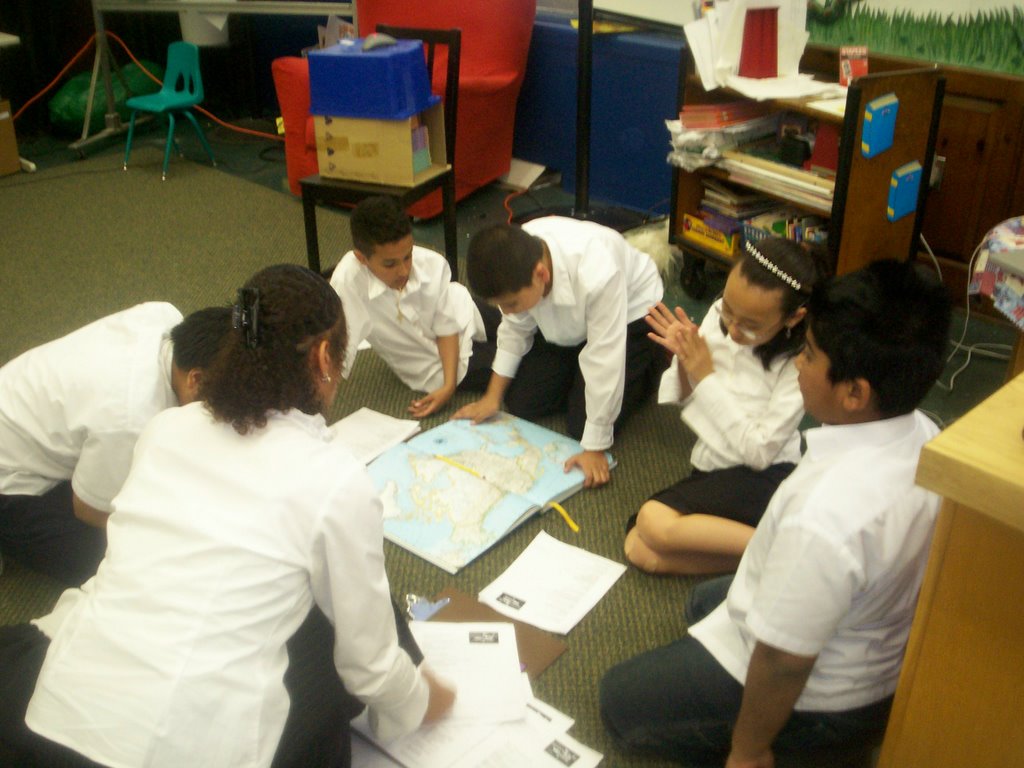
Now back to MysteryQuest. The MysteryQuest was about the western hemisphere. The 6th grade students had chosen the country of Guatemala. One of my colleagues had visited there this summer so I suggested she go in the class and share her stories and photos. She did. Some of the students worked on a powerpoint presentation. They had to pick a city too. So they chose Chichicastenango where many of the photos were from. They had to present clues for the city and country. Today they videoconferenced with six other classes. All had a mystery country and city. All had a presentation. All gave clues. Next the students were given 35 minutes to do research. We divided the class into 6 teams each used maps, an atlas, books and the internet to try and guess the mystery city. The Principal walked in when one of the other classes was presenting. She got so involved she did not leave until the end.

The enthusiasm and interest during the research part is amazing. After that the classes get to ask a clarifying question for each group. For example does your county start with the letter "G". If you get a yes you know you're on the right track. A no means back to the books. The students are given another desperate 10 minutes. Then it is time for the guesses.
Of our six teams, four got the country and city right, one got the country right but the city wrong and one wasn't in the right country. As for our mystery country and city, EVERYONE got Guatemala but NOBODY got Chichicastenango!

Monday, February 13, 2006

Dr. Ben Carson


Yesterday as New York City's blizzard was breaking its own snow accumulation record I was sure the NYC schools would be closed. Now I love snow days as much as anyone else but I knew that today was the Dr. Ben Carson videoconference and my joy for a snow day was tempered by my disappointment of missing this special event. So, when Mayor Bloomberg, in the tradition of the mayors before him, said the NYC schools would be opened I was happy for this one reason. We would be to participate in this videoconference.
Dr. Carson has been healing and educating children for years. He is a brilliant pediatric neurosurgeon. He
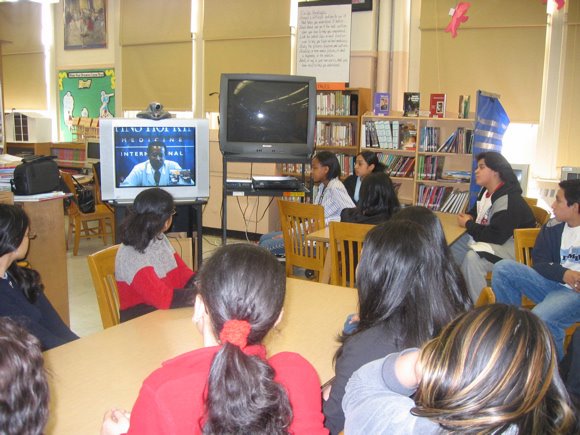
has separated conjoined twins and performed countless life saving surgeries on the brain and spinal system. However, in the words of Dr. Carson his greatest pride comes not from those individual lives he saves through operations but from the impact he has made on so many countless lives through his books, talks and philanthropic work. Today was one of those inspirational meetings. Dr. Carson spoke to classes of students spread across the United States. He talked about his childhood in Detroit. His feelings of stupidity. His single parent home. The positive influences he found. His accomplishments in medicine. Six of the participating schools asked him prepared questions. Which he answered with long and thoughtful answers.
I looked at the faces of the students at IS126, the school that was participating in New York. They were listening attentively. I tried to see who he might be having an effect on. But you really never know whose life will be forever changed by such an encounter.
I really liked this videoconference. I enjoyed listening to this man who was so accomplished and caring. I think it was better than a snow day.

Saturday, February 11, 2006

Poetry Slam Winter 2006


Our Winter Poetry Slam is over and it was wonderful. Tuesday, Wednesday and Thursday saw eight of our 5th through 7th grade classes participating in a friendly competion of original written poetry performances. Our Queen's finalists even had the opportunity to go on to Slam with another school Region in the Bronx. In all their were a total of six slams involving 22 different connections and not one site was unable to connect. That is technology at its best.
Of course this wasn't the case the week before our Poetry Slam. No, the week before saw "Murphy's Law" in full effect. A cable modem at one school inexplicably stopped working, another cable line got chewed up in a door, and the icing on the cake was that six of our 8 Polycom VSX7000's had a software version that would crash the bridge if they were not updated to a later version. On a personal note I had to be in California for a family event and so I was working against a ticking clock. Miraculously, the cable repair was done as scheduled in both schools. So much for the bad rap the "cable repair guy" gets. I was able to remotely, with the cooperation of school techs, upload the new software from 7.5 to 8.0. And I flew to California on Friday and back to New York on Sunday without any airport closings because of a winter snowstorm (fortunately it's not this weekend where over a foot of snow is expected). So, on Tuesday morning we were ready to SLAM!
Our Poetry Slams were great. Our students and their poetry was just wonderful. The poets from UrbanWord, the spoken word residency that had been in the schools for ten weeks working with the students, were there supporting their students. So were their teachers, classmates and school administrators. I hope to post a link soon to some of those performances. In one e-mail I received from a principal he said " I must say it was a tremendously positive experience!  Thank you for bringing such a wonderful opportunity to our kids."
I am so proud of our teachers, our poets, our tech support, our administrators, our judges but most of all our students for such a spectacular event. Next month we will host an Open Mic in one of our schools where all the students, not just the team members, will get a chance to perform their poems. Then of course there is our Spring Poetry Slam in May where we get to do it all over again.